
What this autumn’s weather means for trees across North London and Hertfordshire
Two named storms arrived inside three days this month. Storm Austen brought a yellow wind warning across southern England on 20 October with power cuts and a risk of injury from flying debris. Storm Boelo followed two days later across the north. They were the first two of the 2026 to 2027 season and there will be more before spring. What makes this particular autumn different is the state the trees are in before the wind even reaches them.
The drought has left trees weaker than they look
England came through its driest July on record this summer, with drought declared across almost three-quarters of the country by the middle of August. Trees responded by shedding leaves early and shutting down growth, which kept them alive but cost them reserves they would normally carry into winter.
The part that catches people out is the timing. Research on drought-stressed beech found that trees losing water-conducting function in a dry year did not recover it the following season, so the thinning and dieback showed up a year after the drought rather than during it. A tree that looked tired in September can be structurally weaker now than it was in spring, and wind is an unforgiving way to discover that.
Early season storms do more damage than midwinter ones
A tree in full leaf behaves like a sail. The canopy gives the wind a far larger surface to push against than bare branches do. In late October most deciduous trees around North London are still carrying the bulk of their leaves. An eight-year study of street trees found that most branch failures happened while the trees were in leaf rather than during the bare months.
Saturated ground compounds it. Autumn rain softens the soil holding the root plate at exactly the point when the canopy is catching the most wind, so the anchorage weakens as the load increases. That combination is why the first gales of the season bring down trees that stood through worse weather in January, and it is a different failure pattern from the sudden limb drops seen on still summer days.
What a tree at risk looks like
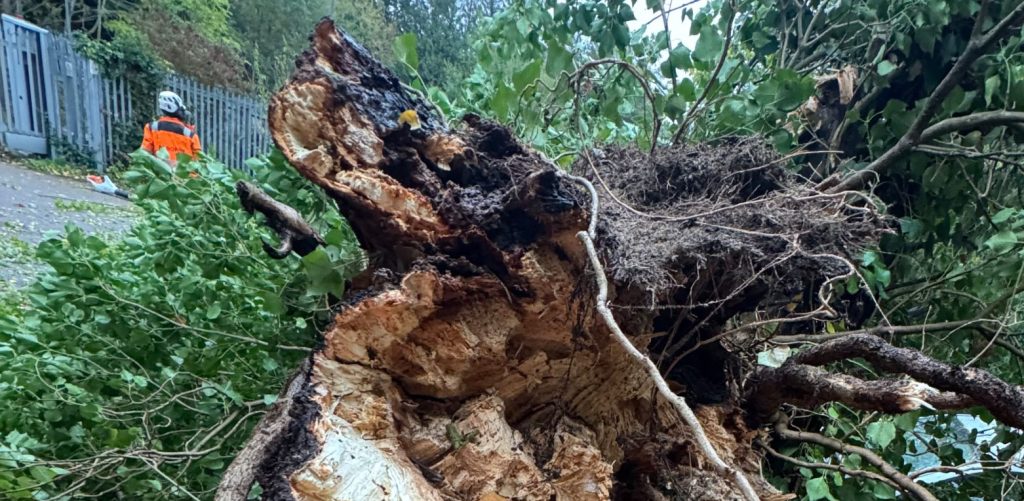
The ground tells you more than the canopy does. Cracked or lifted soil on one side of the trunk with a dip opening on the opposite side means the root plate has started to move. That is the most serious sign there is and it warrants a call the same day rather than at the weekend.
A lean that has appeared or deepened recently points the same way. Trees that have grown at an angle for decades are usually settled, while one that has shifted over a single season or after a single storm is failing slowly rather than leaning naturally. Look also for fungal brackets at the base or on the buttress roots, because the bracket is the fruiting body of decay that has already been running through the structural wood for years. The fungi involved are ones to learn by sight. A vertical crack or seam running more than a metre up the stem, particularly one that opens and closes as the tree moves, means the trunk is partly failed already.
Check the trees that stayed standing too
A tree can lose much of its anchorage in one storm and remain upright, then come down in the next one with no further warning. After a windy night it is sensible to walk the garden and look at the ground around the base of anything large, not only at the trees that have obviously suffered. Fresh soil cracking, turf lifted on one side or roots that were buried last week and are visible now all mean the tree moved, whatever the trunk looks like. The wider damage a severe storm can do is easy to see, while this kind is not.
What to do if you are worried about one
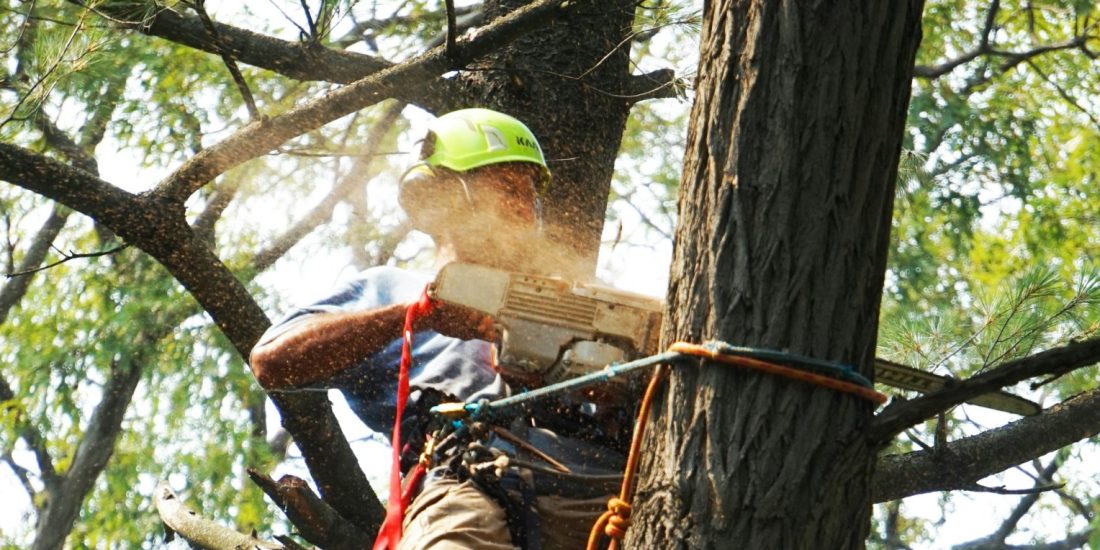
Resist the urge to deal with it yourself. A compromised tree under wind load is unpredictable, and a partly failed stem can release while someone is standing underneath it with a chainsaw. Where a tree is leaning over a road, a neighbour’s roof or anywhere people pass, treat it as an emergency and get it looked at straight away.
Responsibility sits with whoever owns the land the tree grows on, including where it overhangs a pavement or a boundary, so a known problem left unattended is difficult to defend afterwards. Protected trees are not an obstacle in a genuine emergency either. Work needed to remove an immediate danger can go ahead without waiting out a conservation area notice period, provided the council is told what was done. For anything short of urgent, an inspection and a phased plan costs less and keeps the tree where keeping it is possible. Learning to recognise the early signs of decline pays off long before the next storm arrives.
FAQs
How do I know whether a leaning tree is dangerous?
Age of the lean is what counts. A tree that has grown at an angle for years and has straightened its upper growth towards the light has adapted to it. A lean that has appeared or increased over one season, especially with disturbed soil on the raised side, means the root plate is moving and needs looking at quickly.
Should I have a tree cut back before the winter storms?
Reducing the crown lowers the sail area and takes weight off the structure, which lowers the load in high wind. It has to be done with judgement though, because topping a tree hard creates weak regrowth that fails more readily in a few years. A measured reduction by someone qualified does the job that heavy cutting cannot.
My tree dropped a lot of leaves early this summer. Is it dying?
Early leaf drop in a drought is a survival response rather than a death sentence, so the tree is probably alive. It will be carrying less in reserve than usual, which is the reason to have it looked over before winter rather than to assume the worst.
Who is responsible if my tree falls on next door?
The owner of the land the tree stands on. Liability turns on whether the failure was foreseeable, so a tree with visible decay or recent root plate movement that was left alone is a far weaker position than one that failed without warning. A documented inspection is what shows the risk was being managed.
Can I get a protected tree removed in an emergency?
Yes. Work required to remove an immediate danger can proceed without serving the usual notice, as long as the council is informed afterwards and evidence of the condition is kept. Photographs taken before the work are what make that case stand up later.
Get a tree looked at before the next storm blows through
Most storm callouts involve a tree that had been showing something for months. As an ARB Approved Contractor working across North London and Hertfordshire, Thor’s Trees can assess condition and stability through a survey and report, take weight out of a top-heavy crown with ongoing tree maintenance, and deal with anything already down through storm damage clearance. There is a 24 hour emergency call-out for trees that cannot wait, and managed sites and estates are covered by our commercial team.