


How to identify it, what it harms and how to remove it
Few plants can empty a room at a dinner party quite like this one. Japanese knotweed has spent twenty years being described as the plant that eats houses and the reality has turned out to be more measured than that. It still needs dealing with but It doesn’t deserve the panic that usually comes with it.
Late summer and early autumn happen to be the easiest weeks of the year to spot it. The plant is in flower now and at full height. It is also the point in the season when treatment works best.
What does Japanese knotweed look like?
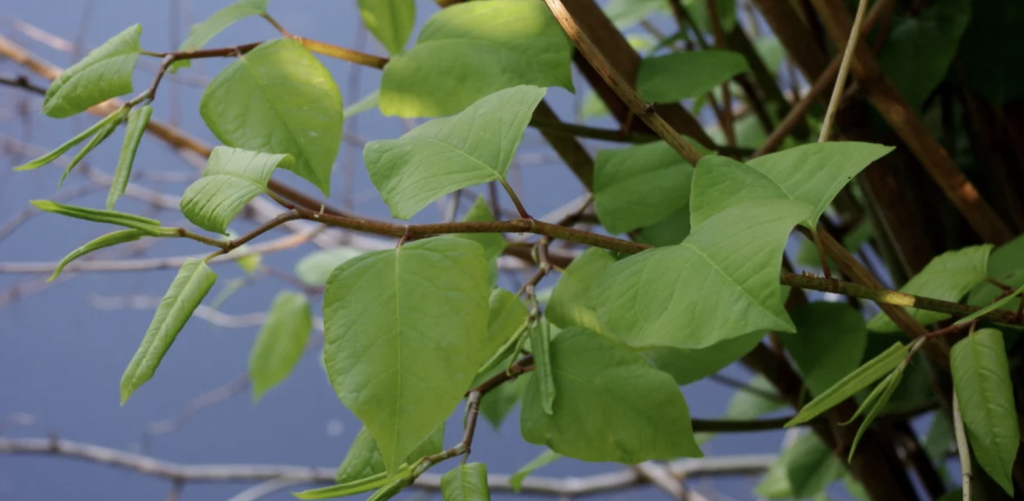
The stems are the biggest giveaway, they are hollow and green with purple speckles and they look like bamboo canes. Leaves are shield shaped with a flat base and a pointed tip and run about 10cm to 15cm long. They sit in an alternating pattern that gives the stem an obvious zig-zag. Creamy white flower clusters appear from late August into September. A mature stand reaches two to three metres and can put on 10cm in a day during spring.
It looks different in every season – red and purple shoots come through in spring like asparagus spears. Leaves yellow and drop in autumn. Winter leaves nothing but orange-brown dead canes standing in place, which is the hardest time of year to be sure of anything.
Plenty of harmless plants get mistaken for it, bindweed climbs on thin stems rather than standing up on canes. Bamboo has long narrow leaves rather than shield shaped ones and Houttuynia tops out around 30cm. The RHS identification guide is a sensible place to compare before anyone panics.
Japanese knotweed damage, and what it will not do
This is where the story has changed – RICS updated its guidance in 2022 and dropped the old rule that treated any knotweed within seven metres of a building as a problem. The current position is that substantial structures on sound foundations are unlikely to suffer structural damage from it.
What it does damage is softer stuff like: Tarmac drives, patios, drains, garden walls and outbuildings are all fair game and it works by exploiting cracks and joints that were already there rather than boring through solid concrete. If left alone it will also shade out everything else in a border.
The real cost tends to be financial rather than structural. Lenders ask questions, sales stall and buyers negotiate. That is the damage most people meet in practice.
Where you stand legally
Having Japanese knotweed on your land is not an offence. Nobody is going to prosecute you for a stand of it at the bottom of the garden. What the Wildlife and Countryside Act 1981 does make an offence is planting it or otherwise causing it to grow in the wild.
Letting it cross a boundary is a different matter. Knotweed spreading onto a neighbour’s land can be an actionable nuisance and the courts have awarded damages for it, though the Supreme Court narrowed what is recoverable in Davies v Bridgend County Borough Council in 2024. Ordinary obligations between neighbours apply here in much the same way they do with overhanging branches.
Disposal is regulated too which means knotweed and any soil containing it count as controlled waste and have to go to a licensed site. Tipping it in the green bin is not an option.
How to get rid of Japanese knotweed
Make sure you’re thinking of what not to do first. Strimming or mowing a stand breaks the rhizome into fragments and a piece the size of a fingernail can start a new plant. Digging it out casually spreads it around the garden and more knotweed problems are created by well meaning weekends than by the plant itself.
Herbicide is the usual route and Glyphosate applied after flowering in late summer or early autumn travels down into the rhizome while the plant is drawing nutrients back for winter, which is why the timing counts. Expect at least three growing seasons before it is genuinely dead. Excavation is quicker and far more expensive and can be done at any time of year.
Use a firm accredited by the Property Care Association and get an insurance-backed guarantee of five or ten years in writing. That guarantee is the document a mortgage lender will want to see later, and checking accreditation before you commit is as sensible here as it is with any tree work.
Selling a house with it
Sellers have to declare knotweed on the property information form. Saying no when you knew otherwise has landed people in court for misrepresentation. A treatment plan with a transferable insurance-backed guarantee is usually enough to keep a sale moving, and since the RICS change the hit to value is often limited to the cost of the remediation itself.
FAQs
Is Japanese knotweed illegal to have in your garden?
No. It is not an offence to have it growing on your own land. It is an offence to plant it or cause it to grow in the wild, and you can be liable in nuisance if you let it spread onto someone else’s property.
Can Japanese knotweed really grow through concrete?
It pushes through cracks and joints that already exist and widens them. RICS guidance is that substantial buildings on sound foundations are unlikely to suffer structural damage.
How long does it take to kill Japanese knotweed?
At least three growing seasons with herbicide, and often longer. Excavation removes it in one go but costs considerably more. Treat any promise of a single treatment with suspicion.
Will Japanese knotweed stop me from getting a mortgage?
Most lenders want a professional treatment plan and an insurance-backed guarantee rather than proof the plant has gone, so getting that paperwork in place is the practical fix.
Get it identified before you touch it
The worst thing to do with a suspected stand is attack it with a strimmer. The second worst is to leave it another season. Identification settles the question quickly and a fair number of suspected cases turn out to be dogwood or bindweed. As an ARB Approved Contractor working across North London and Hertfordshire, Thor’s Trees can tell you what is growing on your land during a site survey and clear the overgrown vegetation and scrub around it so a treatment programme can reach the plant. Trees and shrubs caught up in it are covered by our residential tree care side. Treatment itself should always go to a firm that can hand you an insurance-backed guarantee, because that is the document a lender asks for.